FinOps Roles and Responsibilities: Who Owns Each Cloud Cost Decision
Who should discover, prioritize, approve, execute and validate a cloud cost optimization: a RACI matrix for FinOps, Finance, Platform Engineering and workload owners.
· 18 min read
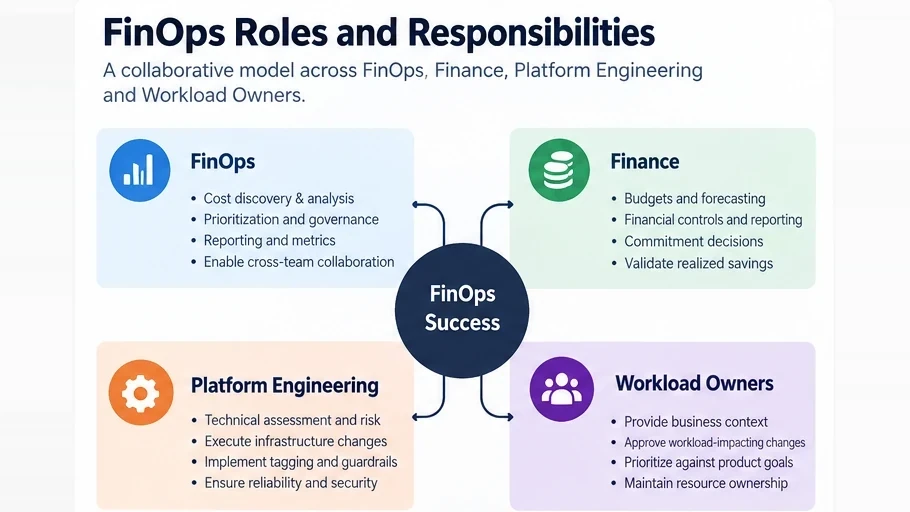
FinOps works best when nobody can say, “Cloud cost belongs to somebody else.”
That does not mean everybody should own every FinOps task.
Effective FinOps roles and responsibilities separate several very different activities: discovering a cost problem, determining whether it matters, deciding whether a change is acceptable, executing that change, and proving afterward that the expected saving actually occurred.
When those responsibilities are blurred, familiar problems appear:
- FinOps recommends hundreds of optimizations that engineering never implements.
- Engineers delete resources because a cost dashboard labels them “idle” without knowing whether the business still needs them.
- Finance reports theoretical savings as realized savings.
- Product and workload owners are asked to approve infrastructure decisions they do not understand.
- Platform teams become the approval bottleneck for every small optimization.
- Nobody knows who should investigate an anomaly.
- Savings reports become impossible to reconcile with actual spend.
The FinOps Foundation defines FinOps as a collaborative operational framework connecting engineering, finance, and business teams. Its current persona model reinforces that FinOps is not something performed only by a central FinOps team: multiple stakeholder groups participate in managing technology value.
That leads to a useful operating principle:
FinOps should coordinate the decision system. It should not become the owner of every decision inside that system.
The clearest way to implement that principle is to define ownership across five stages:
Discover → Prioritize → Approve → Execute → Validate
Each stage needs a different combination of FinOps practitioners, finance, platform engineering, and workload owners.
FinOps Is a Shared Responsibility, Not a Single Team
Organizations often start FinOps by hiring one analyst and expecting that person to “own cloud cost.”
That can work for basic reporting.
It does not scale into an operating model.
The FinOps Foundation describes FinOps as a practice in which everyone takes ownership of their technology usage, supported by a central best-practices function. Engineering, finance, product, leadership, procurement, and FinOps practitioners contribute different expertise to the same economic decisions.
The central FinOps team therefore acts primarily as an enabler and coordinator.
Its job includes:
- making cost and usage visible;
- establishing allocation models;
- detecting anomalies and optimization opportunities;
- maintaining shared metrics;
- enabling budgeting and forecasting;
- connecting technical cost with business value;
- establishing optimization processes;
- and ensuring that actions are measured consistently.
Engineering contributes the technical context that cost data alone cannot provide.
Finance contributes financial definitions, budgets, accounting treatment, and reporting controls.
Workload owners contribute application context and business priorities.
Procurement becomes especially important for commitments and vendor agreements.
Leadership sets objectives and resolves trade-offs that cross organizational boundaries.
A functioning FinOps organization therefore needs more than a list of job titles.
It needs clearly defined decision rights.
The Five Stages of FinOps Responsibility
A cloud optimization should move through a predictable lifecycle.
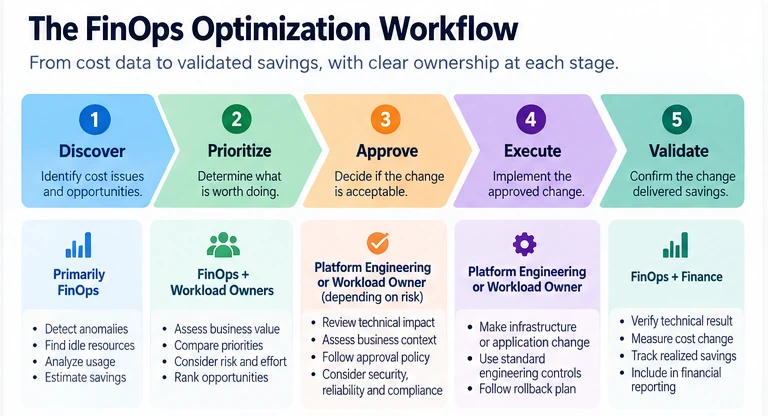
Validate covers both checks described below: engineering verifies the technical result, and FinOps and Finance measure and report the cost change.
1. Discover
Identify an anomaly, unused resource, inefficient architecture, allocation gap, commitment issue, or other opportunity.
2. Prioritize
Determine whether the finding is worth acting on compared with competing engineering and business priorities.
3. Approve
Decide whether the proposed action is acceptable given reliability, security, operational, financial, and business risk.
4. Execute
Perform the infrastructure, configuration, procurement, or application change.
5. Validate
Determine whether the action produced the expected technical result and whether the expected financial impact materialized.
These stages should not automatically belong to the same team.
Someone who discovers a cost issue is not necessarily qualified to approve its production impact.
Someone who executes a change should not independently define whether it was financially successful.
Separation creates both safety and accountability.
FinOps Roles and Responsibilities Matrix
The following responsibility matrix works as a practical starting point for many organizations.
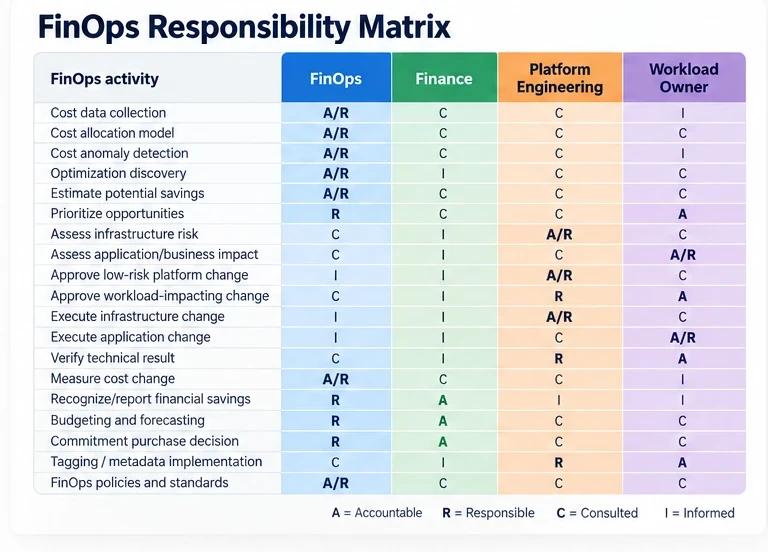
A = Accountable — ultimately owns the outcome
R = Responsible — performs the work
C = Consulted — provides required input
I = Informed — receives the result
| FinOps activity | FinOps | Finance | Platform Engineering | Workload Owner |
|---|---|---|---|---|
| Cost data collection | A/R | C | C | I |
| Cost allocation model | A/R | C | C | C |
| Cost anomaly detection | A/R | C | C | I |
| Optimization discovery | A/R | I | C | C |
| Estimate potential savings | A/R | C | C | C |
| Prioritize opportunities | R | C | C | A |
| Assess infrastructure risk | C | I | A/R | C |
| Assess application/business impact | C | I | C | A/R |
| Approve low-risk platform change | I | I | A/R | C |
| Approve workload-impacting change | C | I | R | A |
| Execute infrastructure change | I | I | A/R | C |
| Execute application change | I | I | C | A/R |
| Verify technical result | C | I | R | A |
| Measure cost change | A/R | C | C | I |
| Recognize/report financial savings | R | A | I | I |
| Budgeting and forecasting | R | A | C | C |
| Commitment purchase decision | R | A | C | C |
| Tagging / metadata implementation | C | I | R | A |
| FinOps policies and standards | A/R | C | C | C |
This is not a universal rulebook.
Organizations with different structures will move responsibilities around. In a small startup, one person might occupy three of these columns. In a large enterprise, each column may represent dozens or hundreds of people.
The important requirement is not the exact letter.
It is that every important activity has a known owner.
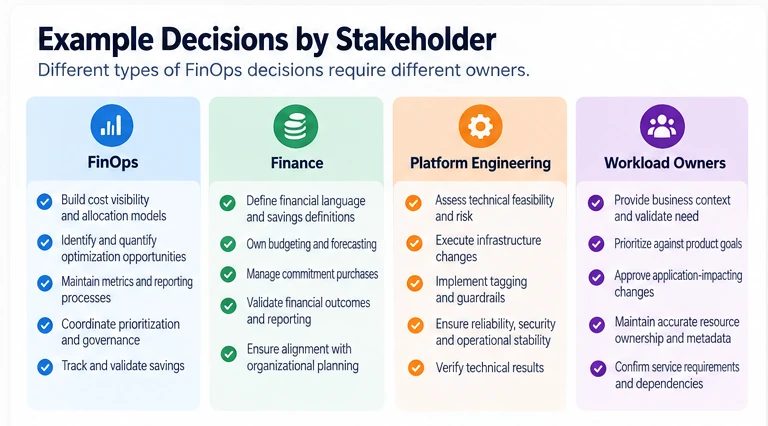
FinOps Practitioner Responsibilities
The FinOps team should own the economic operating system, not every infrastructure resource.
The FinOps Foundation describes practitioners as the bridge between engineering, finance, and business stakeholders. Their goal is to create accountability and support data-backed technology decisions.
That makes FinOps the natural owner for cost intelligence.
FinOps should own cost discovery
FinOps should continuously identify:
- unusual spending changes;
- idle resources;
- underutilized capacity;
- unattached storage;
- commitment underutilization;
- poor allocation;
- missing tags;
- budget variance;
- cost concentration;
- inefficient services;
- and potential rightsizing opportunities.
A platform engineer should not need to manually search the AWS bill every morning to discover that a forgotten test environment suddenly generated $8,000.
The central FinOps process should surface that information.
FinOps should quantify opportunity
A recommendation without financial context is difficult to prioritize.
“Resize this database” is less useful than:
This database costs approximately $4,300 per month. The proposed configuration is estimated to reduce that by $1,200 per month.
The estimate is not yet realized savings.
It is a decision input.
FinOps should make that distinction clear.
FinOps should coordinate prioritization
FinOps can rank opportunities by:
- estimated financial impact;
- severity;
- age;
- confidence;
- environment;
- team;
- account;
- service;
- or business unit.
But pure dollar value should not determine the final implementation priority.
A $2,000 saving affecting a critical payment system may deserve lower implementation priority than a $500 saving on an obviously abandoned development resource.
FinOps provides the economic evidence.
The business and technical owners provide context.
Finance Responsibilities in FinOps
Finance is not simply the group that receives a monthly cloud report.
The FinOps Foundation describes Finance as responsible for accurate technology budgeting, forecasting, reporting, financial context, invoice management, and related financial controls.
That makes Finance particularly important at the beginning and end of the FinOps lifecycle.
Finance defines the financial language
Consider the word savings.
It could mean:
- potential savings;
- negotiated savings;
- avoided cost;
- realized infrastructure reduction;
- invoice reduction;
- amortized commitment benefit;
- budget reduction;
- or forecast improvement.
Those numbers are not interchangeable.
Finance and FinOps should agree on definitions before reporting them to leadership.
Finance owns formal budget accountability
FinOps produces detailed cloud forecasts and provides technical assumptions.
Finance owns how those forecasts integrate with organizational planning.
For example:
FinOps may forecast AWS spend at $8.2 million.
Platform Engineering may predict a migration will remove $600,000.
Product may forecast usage growth that adds $900,000.
Procurement may negotiate new commitment pricing.
Finance combines these inputs into the organization's financial forecast.
Finance should validate reported financial outcomes
FinOps may measure the estimated or observed cost impact after an infrastructure action.
Finance determines how that impact should be represented in formal financial reporting.
This separation prevents technical estimates from silently becoming accounting claims.
Platform Engineering Responsibilities
Engineering is where FinOps recommendations meet production reality.
The FinOps Foundation's Engineering persona covers teams that design, build, operate, and optimize technology systems while balancing cost against performance, reliability, security, and other requirements.
That means engineering cannot be reduced to the team that “implements what FinOps says.”
Platform Engineering should own technical feasibility.
Platform Engineering assesses risk
Suppose FinOps detects an EC2 instance with 5% average CPU utilization.
The financial evidence suggests it is oversized.
That does not prove that resizing it is safe.
Engineering may know that:
- memory utilization is high;
- CPU bursts occur during month-end processing;
- vendor support requires the current size;
- the workload has unusual latency requirements;
- the application cannot tolerate a restart;
- or a migration is already planned.
FinOps should surface the opportunity.
Engineering should evaluate the infrastructure implications.
Platform Engineering executes infrastructure changes
For shared cloud infrastructure, Platform, DevOps, SRE, or Cloud Engineering teams are usually best positioned to execute changes such as:
- instance resizing;
- storage changes;
- cluster configuration;
- autoscaling policy updates;
- lifecycle rules;
- networking changes;
- infrastructure cleanup;
- and shared platform configuration.
Execution should use the same engineering controls as other production changes.
FinOps does not eliminate:
- infrastructure as code;
- peer review;
- deployment pipelines;
- change management;
- observability;
- security controls;
- or rollback planning.
Cost optimization is still engineering.
Workload Owner Responsibilities
The workload owner is often the missing role in FinOps responsibility models.
A cloud resource exists because something uses it.
Someone should own that something.
Depending on the organization, the workload owner could be:
- an application team;
- service owner;
- product engineering team;
- engineering manager;
- system owner;
- data team;
- ML team;
- or product-aligned DevOps team.
Workload owners decide whether the business needs the resource
FinOps might identify a database that has had almost no connections for 60 days.
Platform Engineering may confirm that it can technically be deleted.
Only the workload owner may know that the database is retained for an annual regulatory process.
That context changes the decision.
Workload owners prioritize against product work
FinOps sees savings.
Product and workload teams see competing objectives.
An optimization requiring two weeks of refactoring may save $400 per month but delay a revenue-producing feature.
That does not automatically mean the optimization should be rejected.
It means prioritization needs business context.
Workload owners approve changes affecting service behavior
If an optimization can affect:
- availability;
- latency;
- capacity;
- customer experience;
- business continuity;
- or application behavior,
the accountable workload owner should participate in approval.
This is one of the most important boundaries in FinOps governance.
Who Should Approve a Cost Optimization?
There should not be one universal answer.
Approval should depend on risk.
Low-risk, reversible change
Examples might include actions with well-understood rollback paths and limited application impact.
Approval can often stay within Platform Engineering under predefined guardrails.
Workload-impacting change
If the change modifies application capacity, architecture, performance, or availability, the workload owner should normally be accountable for approval.
Destructive change
Deleting infrastructure deserves stronger controls than stopping or resizing it.
Irreversible actions should require explicit ownership and verification of retention, backup, and dependency requirements.
Commercial commitment
Savings Plans, Reserved Instances, enterprise agreements, and other contractual commitments are different.
Engineering provides usage forecasts.
FinOps provides coverage and utilization analysis.
Finance and Procurement should hold the appropriate commercial decision authority.
This is why the approval question should not be:
Who owns FinOps?
It should be:
Who owns the risk created by this specific decision?
Execution Should Stay Close to Technical Ownership
A common anti-pattern is building a FinOps team that becomes a second operations organization.
The FinOps team discovers a problem.
Then the same FinOps team logs into production and changes the resource.
That may work for a small environment, but it creates problems at scale.
The team operating a workload generally has the strongest understanding of:
- dependencies;
- maintenance windows;
- deployment processes;
- service-level objectives;
- monitoring;
- rollback;
- and incident response.
Execution should therefore normally remain with Platform Engineering or the workload engineering team.
FinOps provides the economic trigger and tracks the outcome.
Engineering owns the technical change.
Savings Validation Needs Two Checks
A change is not successful simply because an API returned HTTP 200.
Savings validation should happen at two levels.
Technical validation
Did the intended infrastructure change actually occur?
For example:
- Was the instance stopped?
- Was the storage volume deleted?
- Did the cluster scale down?
- Did the lifecycle rule become active?
- Is the new resource type running?
Engineering should own or participate heavily in this check.
Financial validation
Did the expected cost actually disappear or decrease?
That requires cost data after the change.
For example:
A team deletes an apparently unused EBS volume with an estimated saving of $200 per month.
The deletion succeeds.
But perhaps another automation recreates the volume two days later.
Technical execution succeeded.
Persistent savings did not.
FinOps should therefore re-check cost or resource state after an appropriate interval.
Finance can then determine how validated savings should appear in financial reporting.
Potential Savings Are Not Realized Savings
This distinction deserves explicit governance.
A recommendation that could save $10,000 is not $10,000 of savings.
An approved recommendation is still not savings.
An executed recommendation is not necessarily savings either.
A useful lifecycle is:
Potential → Approved → Executed → Technically Verified → Financially Validated
Only then should organizations decide whether to call the value realized savings.
This model prevents a common executive-reporting problem where a dashboard says:
FinOps saved $2 million this quarter.
while the cloud bill barely changed.
The problem is often not dishonesty.
It is inconsistent definitions.
Cost Allocation Is Also a Responsibility Problem
Optimization receives most of the attention, but allocation is equally dependent on clear ownership.
The FinOps Foundation describes allocation as assigning technology cost and usage to responsible organizational groupings using accounts, tags, labels, resource metadata, and related structures.
FinOps can define the allocation model.
Platform Engineering can automate tag enforcement.
But workload teams need to provide correct business metadata.
If nobody knows which application owns a resource, FinOps cannot create accountability merely by producing a better dashboard.
A useful division is:
FinOps: Define taxonomy and measure compliance.
Finance: Align allocation categories with financial structures.
Platform Engineering: Implement enforcement and technical controls.
Workload owners: Maintain accurate ownership metadata.
That makes allocation a system rather than a cleanup exercise.
Centralized, Distributed, or Hub-and-Spoke?
The FinOps Foundation currently describes three common team structures:
- centralized;
- distributed;
- and hub-and-spoke.
A centralized FinOps team can standardize metrics, tooling, governance, and reporting.
A distributed model places FinOps expertise closer to engineering or business units.
A hub-and-spoke model combines central standards with practitioners or champions embedded in teams.
The responsibility matrix still applies in all three models.
What changes is who fills each box.
For a 40-person technology company:
- the CFO may represent Finance;
- one cloud engineer may represent Platform;
- engineering leads may be the workload owners;
- and one DevOps engineer may perform FinOps responsibilities part-time.
For a 10,000-person enterprise, the same columns can represent entire organizations.
The matrix scales because it describes functions rather than job titles.
A Practical FinOps Operating Workflow
A strong optimization workflow can look like this:
Step 1: FinOps discovers
A cost and usage scan identifies an idle or inefficient resource.
The finding contains:
- account;
- owner;
- service;
- estimated cost;
- estimated savings;
- evidence;
- and confidence.
Step 2: FinOps triages
Obvious false positives are rejected.
High-impact opportunities are prioritized.
Step 3: Workload and platform owners review
Engineering validates technical assumptions.
The workload owner provides business context.
Step 4: The correct owner approves
Approval depends on the risk class.
Low-risk platform action → Platform approval.
Application-impacting action → Workload owner approval.
Commercial purchase → Finance/Procurement approval.
Step 5: Engineering executes
The change occurs using controlled infrastructure processes.
Step 6: Technical state is checked
Did the change produce the intended result?
If not, a reversible change should have a defined rollback path.
Step 7: FinOps validates savings
Cost or resource state is checked again later.
The opportunity becomes validated only when the evidence supports it.
Step 8: Finance reports the result
Validated cost changes are incorporated into appropriate forecasts and financial reporting.
This closes the loop.
Where Automation Should—and Should Not—Change Responsibilities
Automation can dramatically reduce FinOps operational work.
It should not erase accountability.
A system can automatically:
- detect idle resources;
- calculate estimated savings;
- find missing tags;
- identify anomalies;
- route approvals;
- execute approved API operations;
- verify resulting resource state;
- and record audit evidence.
But automation should not silently decide business risk simply because it can call the cloud API.
The responsibility matrix remains useful even when machines perform several of the steps.
The question becomes:
Who authorized the policy under which the automation acts?
For example, an organization might decide that unattached non-production storage volumes older than 60 days can be cleaned up automatically after a snapshot.
The automation performs the action.
Platform Engineering and the relevant owners still define the guardrail that makes that action permissible.
How GetFinOps Supports This Responsibility Model
GetFinOps follows a similar separation between cost discovery, decision-making, execution, and verification.
Its findings engine evaluates AWS and Google Cloud cost and usage information and produces findings with a severity, a confidence score and, where the resource can be priced, an estimated monthly saving, which teams can sort by to prioritize. Findings can then move into a remediation workflow rather than remaining static dashboard recommendations.
For supported AWS remediations, approval requests move through an approval queue, where a workspace owner or admin approves them in the app or from a Slack approvals channel, before execution. The execution pipeline applies configured guardrails, performs the AWS action and then checks the result: when it stops an instance or a database, it checks the state AWS reports back, and for other actions it checks that AWS accepted the change. Reversible supported actions can roll back when that check fails. About seven days after a stop or a deletion, its savings ledger looks the resource up again and counts the estimated saving only if the change held.
Running without per-action approval is a policy someone has to authorize, as described above. A workspace owner or admin can let one reversible action type run without per-action approval in one cloud account, and the platform returns it to per-action approval the first time a change of that type fails its check and is rolled back, is found undone at that later re-check, or is run with a safety override.
The platform also keeps findings and executions associated with the cloud account from which they originated, reducing the risk of acting against the wrong account in multi-account environments.
That does not move application accountability into the FinOps tool.
That check is not the same as proving that an application is healthy, and workload-specific validation still belongs with the engineering team operating that service.
This is an important distinction for any FinOps automation platform:
Automation can connect the workflow. It should not erase the responsibilities inside the workflow.
Common FinOps Responsibility Mistakes
“FinOps owns the cloud bill”
FinOps should enable cloud-cost accountability.
It should not become the dumping ground for every dollar of infrastructure consumption.
“Engineering owns cost because engineering created the resource”
Engineering controls much of the infrastructure, but financial planning and business value extend beyond Engineering.
“Finance should approve every optimization”
Finance should govern budgets and financial reporting.
It should not need to decide whether reducing Kubernetes replicas from 12 to 10 is operationally safe.
“The person who finds the saving should execute it”
Discovery does not imply technical authority.
“The dashboard says it is idle, so delete it”
Cost evidence needs ownership context.
“The change executed successfully, so book the saving”
Execution is an event.
Savings are an outcome.
FinOps Roles and Responsibilities FAQ
Who owns FinOps?
No single team owns every FinOps activity.
A central FinOps function typically coordinates the practice, but Engineering, Finance, Product, Procurement, workload owners, and Leadership have distinct responsibilities.
What does a FinOps team do?
A FinOps team commonly manages cost visibility, allocation, forecasting support, anomaly detection, optimization analysis, commitment analysis, reporting, governance processes, and collaboration between financial and technical stakeholders.
Who should own cloud cost optimization?
FinOps should usually own discovery and economic analysis.
Engineering owns technical assessment and execution.
The workload owner should approve changes that affect application behavior or business risk.
Finance owns the formal financial treatment of the outcome.
Who approves FinOps recommendations?
Approval should follow the risk.
Platform Engineering can approve appropriate infrastructure changes.
Workload owners should approve changes affecting applications.
Finance or Procurement should approve material commercial commitments.
Leadership may approve decisions crossing strategic or financial thresholds.
Who validates FinOps savings?
FinOps should measure whether the expected cost reduction occurred.
Engineering should verify the technical outcome.
Finance should define whether and how the saving is recognized in formal financial reporting.
Should FinOps engineers make production changes?
They can in organizations where the FinOps role is also part of the platform or infrastructure organization.
But the role alone should not grant unrestricted production authority.
Changes should follow normal engineering ownership, permissions, approval, and rollback controls.
Is FinOps part of Finance or Engineering?
Either model can work.
The FinOps Foundation notes that organizational placement varies, with FinOps frequently aligned with technology leadership while some organizations place the function closer to Finance.
Access and influence across both groups matter more than the box on the organizational chart.
The Best FinOps Responsibility Model Closes the Loop
The most important question in FinOps roles and responsibilities is not who owns the dashboard.
It is who owns each decision between a cost signal and a measurable business outcome.
A useful model is:
FinOps discovers.
The business and technical owners prioritize.
The owner of the risk approves.
Engineering executes.
Engineering verifies the technical result.
FinOps measures the financial result.
Finance validates how that result is reported.
That separation creates accountability without creating another silo.
It also transforms FinOps from a reporting function into an operating model.
The objective is not to produce more recommendations.
It is to create a reliable path from:
cost evidence → decision → controlled action → verified outcome.
When each step has a named owner, cloud optimization stops depending on spreadsheets, Slack reminders, and goodwill between teams.
It becomes a repeatable business process.
GetFinOps helps connect that workflow by turning cloud cost findings into approval-aware actions with AWS remediation controls and post-change verification, while maintaining visibility across AWS and Google Cloud environments.
Use it to make the process between discovery, approval, execution, and verification explicit—without removing the human ownership required for production and financial decisions.
Sources
- FinOps Foundation: What is FinOps? · finops.org
- FinOps Foundation: FinOps Personas · finops.org
- FinOps Foundation: FinOps Practitioner persona · finops.org
- FinOps Foundation: Finance persona · finops.org
- FinOps Foundation: Engineering persona · finops.org
- FinOps Foundation: Allocation capability · finops.org
- FinOps Foundation: Building FinOps Teams: Roles, Structures, Career Paths · finops.org