AWS EDP Meaning: How the Enterprise Discount Program Works
AWS EDP is a negotiated spend commitment, not a Savings Plan. What counts toward it, how its discount stacks with RIs and Savings Plans, and how to forecast it.
· 17 min read
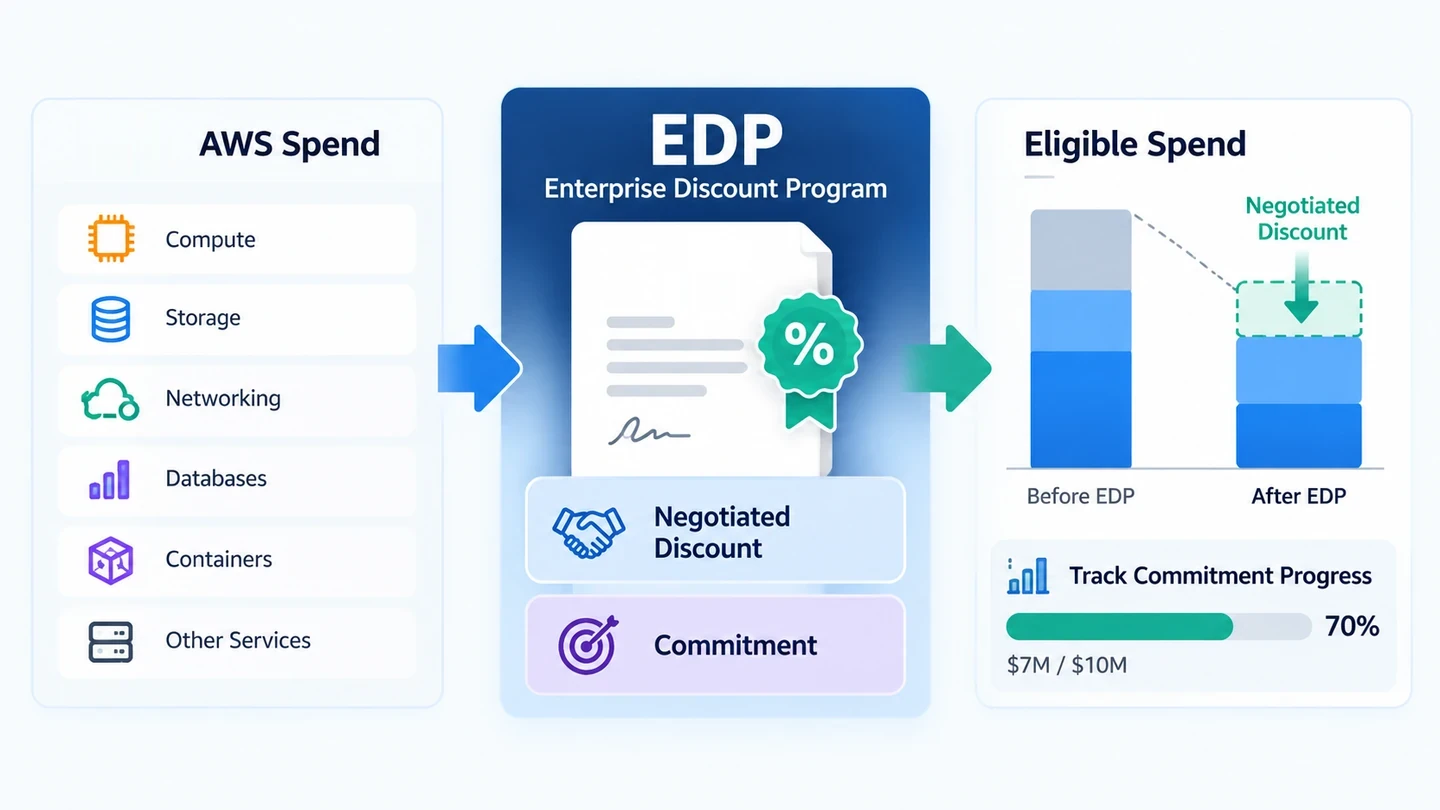
When someone searches for AWS EDP meaning, the simple answer is that EDP stands for Enterprise Discount Program. The more useful answer is that AWS EDP is a privately negotiated commercial agreement designed for organizations with substantial, predictable AWS spending.
Under an EDP, an organization commits to a defined level of eligible AWS spend over an agreed contract period. In return, AWS provides negotiated commercial pricing on eligible usage.
Enterprise agreements with AWS are negotiated individually, and AWS's own Marketplace documentation refers to the committed spend under them as “EDP/PPA”. Unlike a Savings Plan, however, an EDP is not a self-service product with a public discount table that you can simply purchase in the AWS console. The commercial terms are negotiated with AWS.
That distinction matters because the value of an EDP cannot be evaluated from the discount percentage alone.
A FinOps team also needs to understand:
- how much spend the business is committing to;
- which spend counts toward that commitment;
- how AWS Marketplace purchases are treated;
- how Savings Plans and Reserved Instances interact with the negotiated pricing;
- what optimization will do to future spend;
- and whether the organization risks committing to more AWS consumption than it ultimately needs.
The central concept is:
An AWS EDP is a commercial spend commitment. Savings Plans and Reserved Instances are usage-pricing commitments. They can coexist, but their savings must not be counted twice.
What Does AWS EDP Mean?
AWS EDP means AWS Enterprise Discount Program.
It is an enterprise pricing arrangement under which AWS provides negotiated pricing in exchange for a customer committing to an agreed level of AWS spending.
You may also encounter related terminology such as PPA, meaning Private Pricing Agreement, or references to private pricing agreements and EDP together.
The terminology is less important than the contract itself.
The actual agreement defines:
- the commitment amount;
- the commitment period;
- eligible AWS services;
- excluded charges;
- pricing adjustments;
- AWS Marketplace treatment;
- credits;
- organizational scope;
- and any other commercial conditions.
There is therefore no responsible universal statement such as:
“An AWS EDP always gives a 15% discount.”
AWS does not publish one standard EDP discount schedule that applies to every enterprise customer.
A percentage quoted by another company may describe its own negotiated agreement or a market benchmark. It does not automatically describe yours.
For FinOps, finance, and procurement teams, the signed agreement is the source of truth.
AWS EDP vs. Savings Plans: The Most Important Difference
The easiest way to misunderstand an AWS EDP is to treat every AWS commitment mechanism as the same thing.
They are not.
An EDP is primarily a commercial commitment based on eligible AWS spending.
A Savings Plan is a pricing commitment tied to eligible AWS usage.
AWS describes Savings Plans as a pricing model where customers commit to a specified amount of usage, measured per hour, for a one- or three-year period in exchange for reduced rates. AWS currently documents Compute, Database, EC2 Instance, and SageMaker AI Savings Plan types.
The conceptual difference looks like this:
| Mechanism | Commitment | Main purpose |
|---|---|---|
| AWS EDP / PPA | Contract-defined eligible AWS spend | Negotiated enterprise pricing |
| Savings Plan | A defined amount of eligible usage per hour | Lower rates for supported usage |
| Reserved Instance | Service/resource-related commitment depending on RI type | Lower rates and, for some RIs, capacity benefits |
| Spot | No long-term commitment | Lower pricing for interruptible capacity |
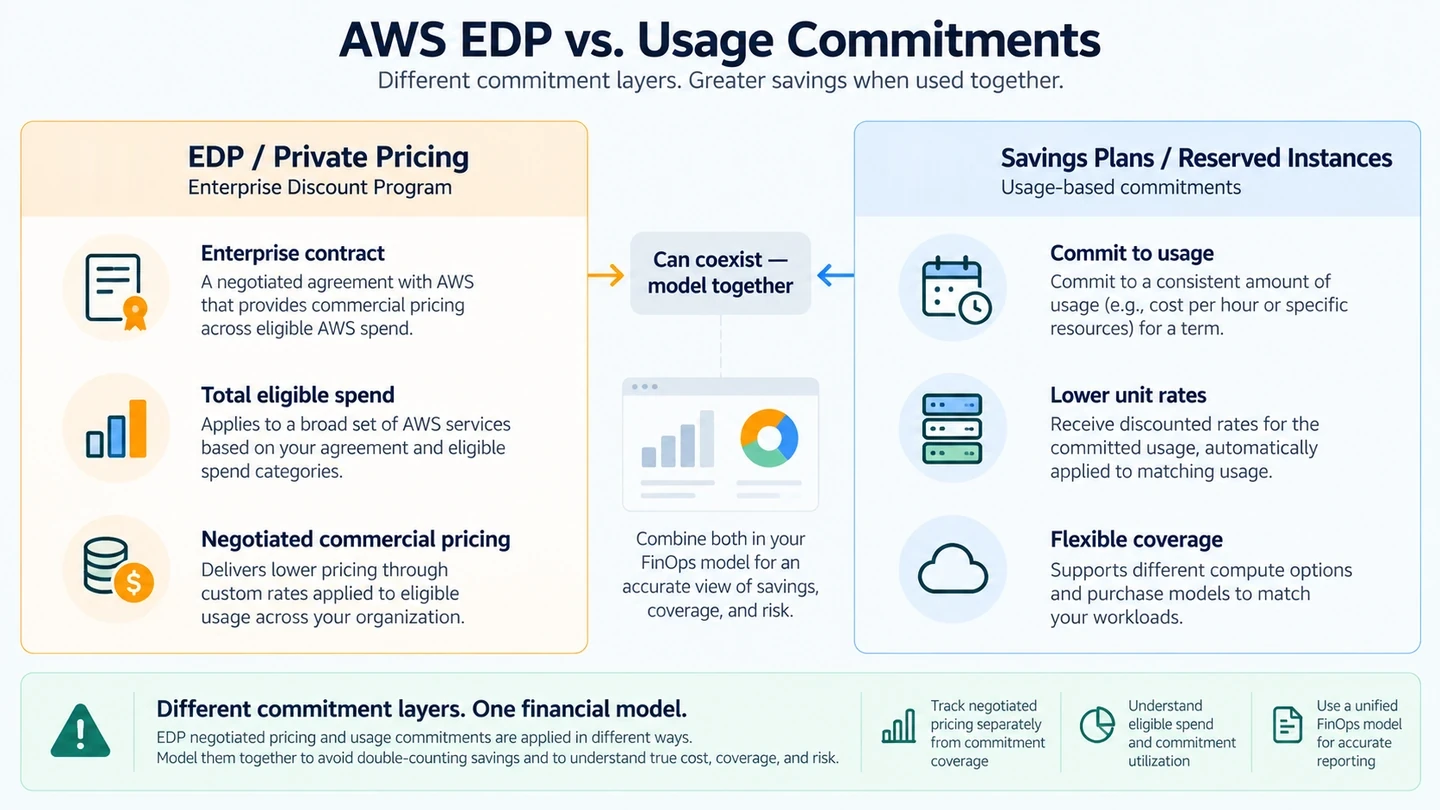
That means an organization can have an EDP and Savings Plans at the same time.
In fact, understanding how the two interact is essential to calculating the real economics of an enterprise AWS agreement.
How AWS EDP Discounts Interact With Savings Plans and Reserved Instances
This is where savings reporting can easily become misleading.
A common assumption is:
- Calculate EDP savings from the full On-Demand price.
- Calculate Savings Plan savings from the same On-Demand price.
- Add the two savings amounts.
That can double-count some of the same dollars.
ProsperOps documents AWS's billing order of operations as follows: AWS calculates Reserved Instance and Savings Plan savings first, and the EDP discount is then applied later to the already RI/SP-discounted spend.
Consider a simplified example.
Suppose a workload would have cost:
$1,000,000 at On-Demand rates.
Savings Plans reduce the relevant cost to:
$700,000.
Savings Plan savings are therefore:
$1,000,000 − $700,000 = $300,000.
Now assume, purely for illustration, that the applicable EDP discount is 10%.
The EDP discount is calculated against the $700,000 remaining after the Savings Plan pricing effect:
$700,000 × 10% = $70,000.
Final cost:
$630,000.
Total savings relative to the $1 million On-Demand baseline are:
$1,000,000 − $630,000 = $370,000.
The correct attribution is:
| Savings layer | Value |
|---|---|
| On-Demand baseline | $1,000,000 |
| Savings Plan benefit | $300,000 |
| Cost after Savings Plans | $700,000 |
| Illustrative EDP benefit | $70,000 |
| Final cost | $630,000 |
| Total benefit vs. baseline | $370,000 |
The wrong calculation would be:
Savings Plan savings = $300,000
EDP savings = 10% × $1,000,000 = $100,000
Total reported savings = $400,000
That would overstate the combined reduction.
The 10% figure above is only an example. Your EDP pricing depends on your actual agreement.
The important concept is the order of attribution.
Use a Savings Waterfall Instead of Adding Discounts
A FinOps organization should be able to start from one reference cost and reconcile every reduction down to the final economic or billed cost.
A useful conceptual waterfall is:
Reference On-Demand cost
↓
Resource and architecture optimization
↓
Reserved Instance / Savings Plan pricing
↓
EDP negotiated pricing
↓
Credits and applicable adjustments
↓
Final cost
The exact accounting representation depends on AWS billing data and your private agreement, but every savings layer should measure the incremental effect from the layer immediately above it.
That prevents one dollar of savings from appearing in several different dashboard categories.
This distinction becomes especially important when executives ask:
How much money did FinOps save?
If your dashboard independently adds rightsizing savings, Savings Plan savings, EDP savings, credits, and architecture savings without maintaining consistent baselines, the resulting number may be impossible to reconcile with the AWS bill.
What Counts Toward an AWS EDP Commitment?
This is one of the most important questions to answer before signing an agreement.
Do not assume:
AWS invoice total = EDP commitment consumption.
Your contract determines what qualifies.
Native AWS service usage will generally be central to the agreement, but organizations should explicitly verify the treatment of every material spend category.
Build an eligibility model containing categories such as:
| Cost category | What to confirm |
|---|---|
| Native AWS service usage | Whether and how it contributes |
| Savings Plan-covered usage | Commitment-retirement treatment |
| RI-covered usage | Commitment-retirement treatment |
| AWS Marketplace | Product eligibility and any limitations |
| AWS Support | Agreement-specific treatment |
| Professional services | Included or excluded? |
| Credits | Effect on eligible spend |
| Refunds | Effect on commitment attainment |
| Taxes | Usually separate from cloud consumption, but verify |
| Adjustments | How corrections affect commitment progress |
The contract should answer these questions before they become assumptions inside your forecast.
AWS Marketplace and EDP Committed Spend
AWS Marketplace can be particularly important to EDP planning.
Some Marketplace purchases can contribute toward AWS committed spend, but Marketplace should not be modeled as one universally eligible category.
AWS explicitly states that customers can use EDP/PPA committed spend for Multi-Product Solutions when the individual products are eligible. AWS also says products deployed on AWS typically qualify, but eligibility is determined separately for each product.
That wording matters.
It means:
“Bought through AWS Marketplace” does not automatically mean “assume 100% EDP drawdown.”
Instead, a FinOps and procurement team should maintain a Marketplace model containing:
- current Marketplace contracts;
- EDP-eligible products;
- renewal dates;
- expected renewal values;
- planned new software purchases;
- private offers;
- payment schedules;
- and the amount expected to contribute to committed-spend retirement.
AWS Marketplace private offers can also contain negotiated pricing, custom terms, and customized payment structures between the customer and Marketplace seller.
That creates another potential pricing layer that needs to be understood separately from the AWS EDP itself.
The Biggest AWS EDP Risk: Overcommitment
An attractive discount can still result in a poor commercial outcome if the commitment is too high.
Imagine an organization spending $12 million per year on AWS.
A forecast predicts rapid growth:
- new customers;
- additional geographic regions;
- a major AI project;
- several on-premises migrations;
- and $2 million of Marketplace procurement.
The company therefore negotiates an aggressive enterprise commitment based on that growth.
Then reality changes.
Engineering moves workloads to Graviton.
Idle EC2 instances are eliminated.
Storage retention is reduced.
Kubernetes clusters are rightsized.
Some workloads move to Spot.
Savings Plan coverage improves.
One migration project is cancelled.
A product is discontinued.
The AI workload is smaller than expected.
A planned Marketplace purchase never happens.
Every one of those decisions may be financially sensible.
They also reduce the spend available to satisfy an aggressively sized enterprise commitment.
This creates an unusual FinOps dynamic:
Successful cost optimization can increase EDP commitment risk if the agreement was sized from an unoptimized forecast.
The solution is not to stop optimizing.
The solution is to include optimization in the commitment model before signing the contract.
Never Size EDP From Gross Invoice Spend Alone
Suppose the business currently sees an AWS invoice of $1 million per month.
That does not automatically mean the organization has $12 million of annual EDP-eligible spend.
The invoice may contain different categories with different commercial treatment.
Some spending may also disappear through:
- Savings Plan purchases;
- Reserved Instance optimization;
- rightsizing;
- workload shutdowns;
- architecture changes;
- contract expiry;
- or business changes.
A stronger forecasting model starts with:
Current eligible spend
then adjusts for:
+ confirmed growth
+ approved migrations
+ eligible Marketplace procurement
− planned decommissions
− optimization
− architecture reductions
± contract-specific adjustments
The result is far more useful than simply annualizing last month's AWS bill.
Forecast AWS EDP in Three Scenarios
One forecast is rarely enough for an enterprise commitment.
Use at least three.
Conservative scenario
Include workloads that are highly likely to remain.
Assume optimization programs succeed.
Apply caution to Marketplace procurement that has not been signed.
Exclude speculative migrations.
Use restrained growth assumptions.
This scenario helps answer:
What commitment could we consume even if growth disappoints?
Expected scenario
Include realistic customer growth, approved migrations, expected Marketplace renewals, and known infrastructure changes.
This should represent the organization's most probable operating plan.
Upside scenario
Include faster business growth, additional migration opportunities, acquisitions, new AI programs, and other plausible expansion.
This scenario helps procurement understand the negotiating upside.
It should not automatically become the minimum committed spend.
A useful commercial agreement gives the business room to succeed without requiring the optimistic scenario to occur merely to avoid commitment pressure.
AWS EDP Commitment Burndown Is Not the Same as Savings
Another common FinOps reporting mistake is confusing commitment consumption with savings.
They are entirely different metrics.
EDP savings asks:
How much did negotiated enterprise pricing reduce cost?
EDP commitment burndown asks:
How much qualifying spend has counted toward our contractual commitment?
A company can have strong negotiated pricing and still be behind its committed-spend trajectory.
Conversely, a company can consume the commitment quickly while spending inefficiently.
Consider a team with an unused EDP commitment.
Buying unnecessary software through Marketplace merely because the transaction can contribute toward commitment drawdown does not create savings.
It converts one financial problem into another.
The objective is not:
Spend enough money to consume the commitment.
The objective is:
Receive the best commercial pricing on AWS spending the business actually needs.
Track EDP as Both Savings and Financial Exposure
Traditional cloud dashboards mostly look backward.
They answer questions such as:
- What did we spend?
- Which service increased?
- Which account caused the spike?
- How much did Savings Plans save?
An EDP creates a forward-looking obligation.
FinOps therefore needs to monitor:
actual eligible spend versus remaining commitment.
An EDP dashboard should ideally include:
- contracted commitment;
- contract dates;
- qualifying spend to date;
- commitment consumed;
- commitment remaining;
- elapsed contract percentage;
- forecast eligible spend;
- expected end-of-term surplus or shortfall;
- native AWS contribution;
- Marketplace contribution;
- major forecast assumptions;
- Savings Plan and RI effects;
- optimization pipeline;
- and forecast confidence.
This lets teams detect commitment risk months before it becomes a procurement emergency.
Savings Plans Can Change Your EDP Forecast
Savings Plans are not only a cost-saving mechanism.
They can change the spend trajectory used in EDP planning.
AWS applies Savings Plan discounts to qualifying usage and supports sharing those discounts across eligible accounts in an AWS Organization according to configured sharing preferences. AWS currently allows organization-wide, group-based, and account-level approaches to RI and Savings Plan discount sharing.
Suppose your organization forecasts $5 million of eligible compute spending.
You then purchase or optimize Savings Plans that materially lower the cost of that same usage.
The original $5 million forecast may no longer represent the amount of spend that will appear after commitment pricing.
If the procurement team maintains an EDP forecast in one spreadsheet while the cloud team manages Savings Plans independently, the two financial models can diverge.
That is why mature FinOps teams model:
enterprise spend commitments + usage commitments + optimization
together.
Optimization Should Continue After You Sign an EDP
An EDP does not make inefficient infrastructure economical.
Imagine that your FinOps program discovers:
- idle instances;
- oversized databases;
- unattached EBS volumes;
- excessive data transfer;
- old snapshots;
- underutilized Kubernetes nodes;
- and poor Savings Plan coverage.
The organization should still optimize them.
It may feel uncomfortable to reduce AWS spend when you have already committed to a spend level.
But intentionally running unnecessary infrastructure simply to satisfy an EDP means the organization is paying for waste to solve a contract-planning problem.
The correct sequence is:
Optimize infrastructure.
Update the EDP forecast.
Recalculate commitment risk.
Adjust future commercial negotiations accordingly.
A cloud commitment should reflect business demand.
Business demand should not be manufactured to support a cloud commitment.
How to Calculate AWS EDP Savings Correctly
Your reporting should clearly label the cost basis used for each savings metric.
For example:
RI / Savings Plan savings
Compare the supported usage cost under commitment pricing with the relevant On-Demand equivalent.
EDP incremental savings
Measure the additional negotiated pricing reduction after the upstream pricing effects that AWS applies.
ProsperOps' explanation of AWS billing methodology is especially useful here: RI and Savings Plan savings are calculated before the EDP discount is applied, while the EDP then creates additional savings on the remaining discounted spend.
Resource optimization savings
Measure the cost avoided because usage itself changed—for example, terminating an idle resource or moving to a smaller configuration.
Credits
Treat credits separately rather than labeling them engineering optimization.
Credits reduce what you pay, but a promotional credit is not the same thing as reducing the underlying cost of running a workload.
These distinctions make savings reports auditable.
Gross Savings vs. Incremental Savings
Suppose an executive dashboard claims:
- $400,000 Savings Plan savings;
- $100,000 EDP savings;
- $150,000 rightsizing savings;
- $70,000 credits.
Can you conclude that FinOps saved $720,000?
Not necessarily.
You need to know the baseline used for each calculation.
If rightsizing already reduced the amount of compute usage, the Savings Plan opportunity may have changed.
If the EDP discount applies after RI/SP pricing, you cannot calculate EDP savings independently against full On-Demand spend.
Credits reduce cash cost but do not necessarily represent infrastructure efficiency.
For this reason, distinguish:
Standalone opportunity
from
incremental realized savings.
The latter is much more valuable for financial reporting.
A Practical AWS EDP Forecasting Model
A robust EDP forecast should work month by month rather than relying only on one annual total.
For each month, estimate:
| Forecast component | Key question |
|---|---|
| Existing eligible workload | What spend is already durable? |
| Organic growth | How will current workloads grow? |
| New migrations | Which projects are actually approved? |
| Decommissions | Which workloads will disappear? |
| FinOps optimization | How much cost should optimization remove? |
| RI/SP changes | How will commitment pricing change spend? |
| Marketplace | Which confirmed eligible purchases contribute? |
| Credits | How do they interact with the agreement? |
| Business uncertainty | What assumptions could fail? |
Then calculate the result under conservative, expected, and upside cases.
Finally compare all three with the proposed commitment.
If the commitment requires your upside scenario merely to break even, the organization is accepting significant forecast risk.
Questions to Answer Before Signing or Renewing an AWS EDP
Before the agreement is approved, finance, procurement, engineering, and FinOps should be able to answer:
- What exact spend retires the commitment?
- Which AWS services qualify?
- Which charges do not qualify?
- How are Savings Plans and Reserved Instances treated?
- Which Marketplace purchases are eligible?
- Are there Marketplace restrictions or limits?
- How are credits treated?
- How are refunds and billing corrections treated?
- Which AWS accounts and Organizations are covered?
- What assumptions are included in the growth forecast?
- What optimization has already been deducted?
- What happens under the conservative forecast?
- How frequently will commitment attainment be reviewed?
- What billing dataset will reconcile the forecast to AWS?
- What happens if expected spend changes materially during the agreement?
Any significant answer that begins with “we assume” should be clarified before signature.
Where GetFinOps Fits
An AWS EDP makes cloud financial management more interconnected.
Engineering optimization affects future eligible spend.
Savings Plans affect workload economics.
Marketplace procurement can influence commitment attainment.
Finance needs accurate forecasts.
Procurement needs contract visibility.
Leadership needs a savings number that does not count the same reduction twice.
GetFinOps helps teams operate on the technical side of that equation by bringing AWS cost visibility, optimization findings, and controlled remediation workflows into a common FinOps process. It also shows Savings Plans utilization and AWS's own Savings Plan and Reserved Instance purchase recommendations as findings for your team to decide on; it never buys a commitment.
For actions the platform can perform in AWS, GetFinOps uses approval-gated execution and a post-change check, including rollback for reversible actions when that check fails.
More complex recommendations remain recommendations for engineering rather than being represented as automatically executed savings.
The connection to EDP planning is important:
Every material optimization changes the forecast.
When AWS waste is removed, the expected cloud run rate should flow back into the organization's commercial commitment model.
FinOps should connect infrastructure decisions and procurement assumptions rather than allowing them to develop independently.
AWS EDP Meaning: Frequently Asked Questions
What does AWS EDP stand for?
AWS EDP stands for AWS Enterprise Discount Program.
It is an enterprise commercial pricing arrangement through which eligible customers can receive negotiated AWS pricing tied to a spending commitment.
Is AWS EDP the same as a Savings Plan?
No.
An EDP is an enterprise commercial spend agreement.
A Savings Plan is a commitment to a defined amount of eligible usage for a specified term in exchange for reduced usage rates. AWS documents one- and three-year Savings Plan terms.
Can you have an AWS EDP and Savings Plans simultaneously?
Yes.
They address different pricing layers and can coexist.
When measuring savings, however, avoid calculating both independently against the same On-Demand baseline.
Which discount is applied first: EDP or Savings Plans?
Published analysis from ProsperOps describing AWS's billing methodology states that AWS calculates RI and Savings Plan savings first and then applies the EDP discount to the resulting discounted spend.
Your own AWS billing data and private agreement should remain the source of truth for financial reconciliation.
Does all AWS Marketplace spending count toward an EDP?
Do not assume that it does.
AWS states that EDP/PPA committed spend can be used for qualifying Marketplace products and that eligibility is determined separately for each product in its Multi-Product Solutions model.
What percentage discount does AWS EDP provide?
There is no single public AWS EDP discount percentage that applies to every organization.
The pricing terms are negotiated.
What is the biggest EDP risk?
A major risk is committing to more eligible AWS spend than the organization ultimately consumes.
Business slowdown, architecture changes, successful FinOps optimization, improved commitment pricing, cancelled migrations, or moving workloads elsewhere can all reduce expected spend.
Should we stop optimizing AWS because we have unused EDP commitment?
No.
Running unnecessary infrastructure to consume a commitment creates waste.
Continue optimizing and treat any resulting commitment shortfall as a commercial forecasting issue.
The Practical Meaning of AWS EDP
The shortest AWS EDP definition is:
AWS EDP is a negotiated enterprise pricing agreement where the customer commits to eligible AWS spending in exchange for commercial pricing benefits.
For FinOps teams, however, four rules are more useful than the definition itself.
Model eligible spend, not merely gross AWS invoices.
The amount on an AWS bill and the amount that retires your enterprise commitment are not concepts you should automatically treat as identical.
Include optimization in the forecast.
Rightsizing, architecture changes, workload removal, Savings Plans, and other efficiency work can materially change future spend.
Treat enterprise and usage commitments as separate layers.
EDP and Savings Plans can coexist, but they solve different commercial problems.
Never double-count the savings.
AWS RI and Savings Plan savings are calculated upstream of the EDP pricing effect. Build a reconciled savings waterfall rather than applying every discount independently to the original On-Demand baseline.
An EDP can materially improve AWS economics when the commitment matches durable demand.
It can also create financial pressure when an attractive discount is paired with an aggressive consumption forecast.
That is why the most important question during an AWS EDP negotiation is not simply:
What discount can we get?
It is:
How much eligible AWS spend can we confidently consume after applying the optimization work we already intend to do?
That is the number a sustainable AWS enterprise commitment should be built around.
Sources
- AWS: Savings Plans types · docs.aws.amazon.com
- AWS: What are Savings Plans? · docs.aws.amazon.com
- ProsperOps: How are RI and SP savings calculations impacted by an EDP? · help.prosperops.com
- AWS Marketplace: Multi-Product Solutions FAQ (EDP/PPA committed spend) · docs.aws.amazon.com
- AWS Marketplace: Private offers · docs.aws.amazon.com
- AWS: Reserved Instances and Savings Plans group sharing · aws.amazon.com
- AWS Billing: Reserved Instances and Savings Plans discount sharing · docs.aws.amazon.com